
Key Takeaways
- Power companies generate electricity from various sources, including coal, natural gas, and renewable sources.
- Your TDU (Transmission and Distribution Utility) owns the poles, wires, and meter that deliver your power. Pogo is your Retail Electric Provider, which sells you the plan. When the power goes out, you call your TDU.
- They use high-voltage transmission lines to transport electricity long distances to substations.
- Substations lower the voltage before sending electricity through distribution lines to homes.
- Power companies monitor electricity flow using advanced software to ensure safe and efficient distribution.
- Customers connect to the electricity grid through service panels, which regulate power to their appliances.
The common thing that all power companies need in order to stay in business is…you guessed it, electricity. Distributing electricity requires a complex process. Electricity is distributed through the electric power grid via a complex network of power plants, high-voltage transmission lines, substations, and transformers. Here’s a brief overview of how electricity distribution works so power companies can power your home and your life.
Power Companies use a complex process to deliver power to homes
- Power Generation: Electricity is generated at power plants, which can be fueled by various sources. These sources include coal, natural gas, nuclear, hydro, wind, and solar power. (Learn more about the power of renewable energy and its distribution).
- High-Voltage Transmission: Once electricity is generated, it is sent to high-voltage transmission lines, which transport it over long distances to substations.
- Substations: Substations are used to regulate the voltage of the electricity. Substations transform the high voltage from the transmission lines to a lower voltage that can be used by homes.
- Distribution Lines: From the substations, the electricity is sent out on distribution lines. Distribution lines are often mounted on poles or buried underground. These lines carry electricity to local transformers, which further reduce the voltage to a level suitable for your homes. (This is why you experience a loss of power when someone crashes into a transformer- sometimes loss of electricity isn’t your power company’s fault, or yours.
- Customer Connection: The final step in the electricity distribution process is the connection to individual homes and businesses. The electricity enters the building through a service panel. Fuses and circuit breakers regulate electricity before it is distributed to power appliances.
Who Actually Owns the Poles and Wires? Meet your TDU
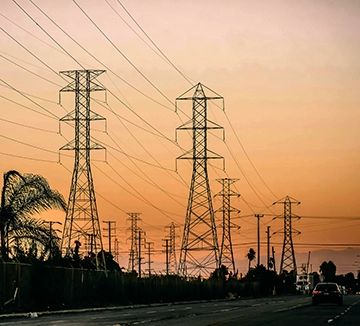
Here’s the part most people never hear about. In Texas, the company that sells you your electricity plan is not the same company that owns the wires bringing it to your door. That second company is your TDU.
TDU stands for Transmission and Distribution Utility. You might also see it called a TDSP, or Transmission and Distribution Service Provider, which is the same thing wearing a longer name. Your TDU owns and maintains the transmission lines, substations, distribution poles, wires, and even the meter bolted to the side of your house. They physically move electricity across every step we just walked through above.
So where does Pogo fit in? Pogo is your Retail Electric Provider, or REP. We sell you the plan, manage your account, and keep your bill straight. Picture ordering something online: Pogo is the store you bought it from, and your TDU is the delivery company that owns the trucks and the roads and actually drops the package on your porch. The electricity is the package. Same power showing up either way, but two very different jobs.
You don’t get to shop for your TDU. It comes with your address. In the areas Pogo serves, the TDUs are Oncor, CenterPoint Energy, AEP Texas (North and Central), and Texas-New Mexico Power (TNMP). Whichever one covers your neighborhood is the one you’ve got.
Here’s the one thing worth tattooing on your memory: when the lights go out, your TDU is who you call, not Pogo. They own the wires, so they’re the crew that fixes downed lines, restores outages, and keeps the grid humming. And because nobody wants to dig up a phone number during a storm, we’ve gathered every TDU’s outage line and outage map for you below.
How Power Companies Monitor the Flow of Electricity
Throughout this process, electricity is continuously monitored and controlled to ensure it is distributed safely and efficiently. Power companies use sophisticated software and equipment to manage the flow of electricity. This software also allows your power company to respond quickly to any outages or other issues that may arise.
Overall, the electric power grid is a complex system that enables the generation and distribution of electricity. With this system, we can meet the needs of homes in Texas. You do not need to worry about electricity distribution. Your power company (hopefully, that is Pogo Energy) will ensure a constant supply of electricity to your home, so your life doesn’t miss a beat.
To keep your energy usage down in order to keep the cost of electricity low, you may want to take some time to review some of our tips to reduce how much money you spend on electricity.
Need Your TDU? Start Here
Not sure who your TDU is, or need to report an outage right this second? Our TDU help pages have the phone numbers, outage maps, and load-shedding details for every Texas TDU we serve.
- Report a power outage to your TDU — phone numbers and outage maps for Oncor, AEP Texas, CenterPoint, and TNMP
- Pogo TDU FAQ — the most common TDU questions, answered